Virtual Power Plant (VPP) Explained: What Perth Homeowners Need to Know Before Joining
If you’ve been looking into the WA Residential Battery Scheme, you’ve almost certainly hit a requirement that gives people pause: to access the rebate, you must join a Virtual Power Plant (VPP). For many Perth homeowners, that sounds like handing control of their battery over to someone else. It isn’t, and this article explains exactly what it means, what you actually agree to, and why the financial upside makes the arrangement worth understanding clearly.
The short answer: a VPP is a network of home batteries that work together to stabilise the grid. Your battery stays yours. You keep priority access. And under Synergy Battery Rewards, you earn 70 cents for every kilowatt-hour exported during activation events.
Here’s everything you need to know before signing up.
What Is a Virtual Power Plant?
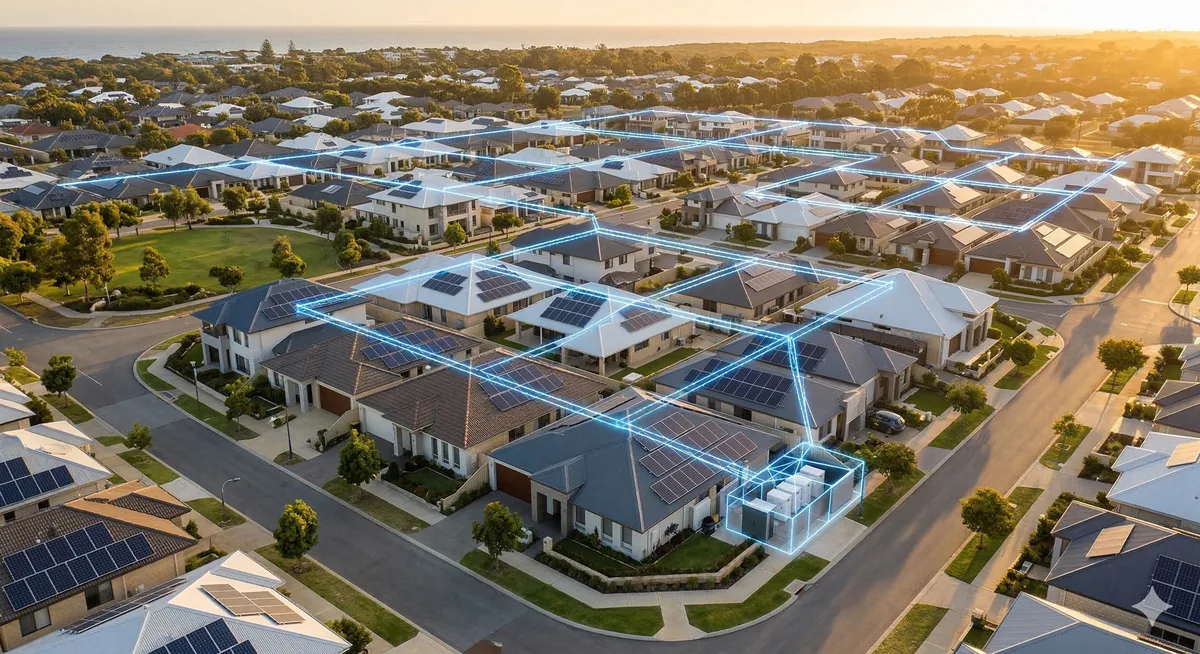
A Virtual Power Plant connects thousands of individual home batteries into a coordinated network that can respond to demand on the electricity grid in real time. Think of it as a large-scale battery made up of many small ones, spread across suburbs rather than sitting in a single facility.
When the grid comes under pressure, such as during a heatwave when air conditioners are running flat out across Perth, the VPP operator can draw a small amount of energy from each participating battery to stabilise supply. The process is automated and happens in the background. You won’t notice it happening.
Why WA Needs a VPP
Western Australia’s South West Interconnected System (SWIS) serves Perth and the broader south-west region. As rooftop solar penetration has grown, the grid has had to manage increasingly variable supply. A VPP provides a flexible buffer that reduces the need for expensive infrastructure upgrades and helps prevent blackouts during peak demand periods.
According to the WA Government’s scheme information, long-term participation helps minimise electricity price inflation for the entire community, including households that haven’t invested in solar or batteries.
Who Operates the VPP?
For most Perth homeowners on the South West Interconnected System, the default VPP is Synergy Battery Rewards, operated by Synergy, WA’s state-owned electricity retailer. Synergy customers can also choose an alternative VPP product offered by their battery supplier, provided it meets the State’s eligibility criteria and is backed by genuine market or service contracts.
The VPP Is Mandatory: Here’s What That Actually Means
To receive a rebate under the WA Residential Battery Scheme, participation in an approved VPP is a condition of eligibility. There is no way around it. But the obligation is far more limited than most homeowners initially assume.
Here is what VPP participation actually commits you to:
- Minimum term: You must remain enrolled in a VPP for at least two years from the date of installation. After that, you are free to opt out.
- Event frequency: Synergy can activate your battery a maximum of 30 times per year.
- Event duration: Each activation event runs for a maximum of 6 hours.
- Total exposure: At the maximum possible frequency and duration, VPP events account for less than 2% of the year. The other 98% of the time, your battery operates entirely for your household.
- Internet connection: You need an ongoing internet connection so the system can be monitored and orchestrated.
The practical reality: most households will never notice the difference. Your battery continues to charge from solar during the day, power your home at night, and provide backup during outages. The VPP sits in the background and activates infrequently.
Busting the 3 Biggest VPP Myths
The hesitation around VPPs is understandable, but most of it is based on misconceptions that circulate online. Here are the three most common ones, and what the evidence actually shows.
Myth 1: “You Lose Control of Your Battery”
This is the most persistent concern, and it’s not accurate. Joining a VPP does not transfer ownership or primary control of your battery to Synergy or any other operator. Your battery’s first job is still to power your home. VPP activation only draws on energy above what your household needs, and the strict caps (30 events per year, 6 hours maximum each) ensure the impact on your daily energy use is minimal.
Myth 2: “It Will Shorten My Battery’s Life”
Grid support discharges energy from your battery in exactly the same way as running your dishwasher or charging an EV. The chemistry doesn’t distinguish between a household load and a VPP event. Modern lithium batteries are rated for thousands of charge cycles, and the additional cycling from VPP participation, given the low frequency of events, has negligible impact on overall battery lifespan.
Myth 3: “The VPP Takes Energy I’ve Paid For”
Under Synergy Battery Rewards, you are compensated at 70 cents per kWh for every unit of energy exported during an activation event. That rate is significantly higher than the standard feed-in tariff available to solar households in WA. Rather than losing energy, you’re selling it at a premium rate during the moments it’s most valuable to the grid.
What You Actually Earn: The Synergy Battery Rewards Breakdown
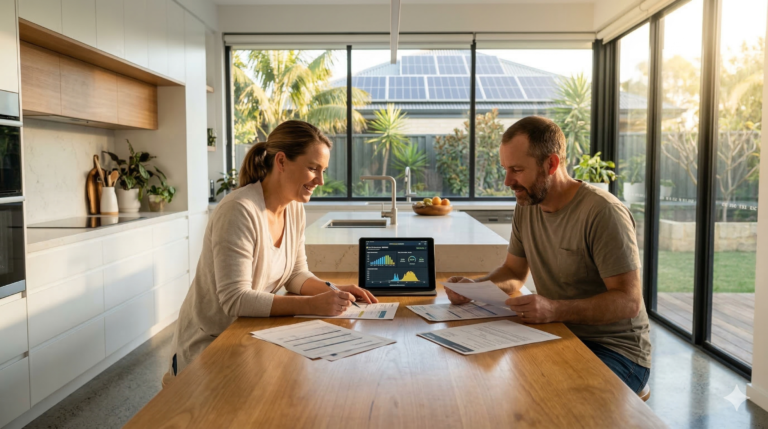
The financial case for joining the VPP goes beyond the upfront rebate. Synergy Battery Rewards credits are applied directly to your Synergy electricity bill, reducing what you owe in the next billing cycle.
How the Credits Work
During each activation event, Synergy exports energy from your battery to the grid and credits your account at 70c/kWh. The credits appear on your next bill, not as a cash payment. For a 10 kWh battery fully discharged during a single event, that’s a $7 credit per event. Across the maximum of 30 events per year, that’s up to $210 in bill credits annually, on top of all the savings your battery already generates through self-consumption of solar energy.
Stacking the Savings
When you add up the full picture, the financial benefits of the scheme are substantial:
| Benefit | Amount |
|---|---|
| WA State Battery Rebate (Synergy, 10 kWh) | Up to $1,300 |
| Federal Cheaper Home Batteries Program | Up to $3,700 |
| Combined rebate (Synergy, 10 kWh) | Up to $5,000 |
| No-interest loan available (income under $210k) | Up to $10,000 |
| Synergy Battery Rewards (max 30 events/yr, 10 kWh) | Up to $210/year |
Note: Federal rebate amounts are subject to change. The WA Government advises checking the latest figures through the official scheme page before applying.
The 70c/kWh VPP credit rate is the part most homeowners underestimate. Over a 10-year battery lifespan, consistent VPP participation could add over $2,000 in bill credits on top of the upfront rebate savings.
The Benefits of Solar and Battery Together
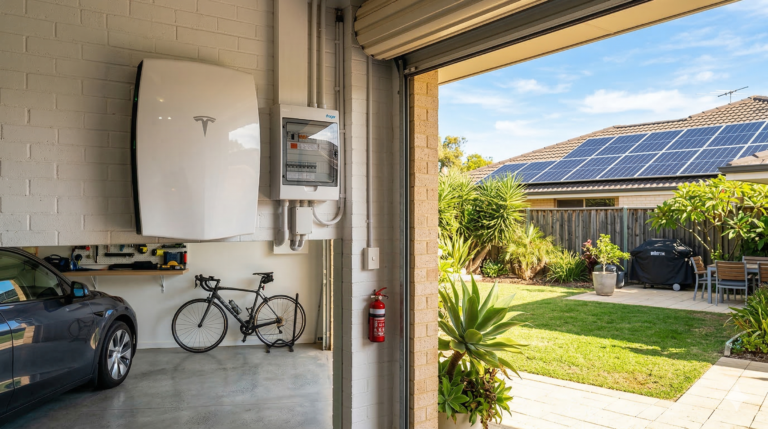
A battery on its own has limited value. A battery paired with a solar system is a fundamentally different proposition, and it’s the combination that makes the WA Battery Scheme most worthwhile for Perth homeowners.
Why Solar + Battery Changes the Equation
Perth receives some of the highest solar irradiance of any capital city in Australia. A solar-only system generates energy during the day but exports surplus to the grid at low feed-in tariff rates, often as little as a few cents per kilowatt-hour. A battery captures that surplus instead, storing it for use in the evening when grid electricity rates are highest.
The result is a dramatic reduction in what you draw from the grid. Rather than exporting cheap solar and buying back expensive evening electricity, you’re self-consuming the energy you generate. Most Perth households with solar and a 10 kWh battery can cover the majority of their evening electricity needs from stored solar energy alone.
What a Battery Adds Beyond Bill Savings
- Energy independence: Less reliance on grid electricity and protection against future tariff increases.
- Backup power: Many battery systems provide blackout protection, keeping essential appliances running during outages.
- VPP income: As outlined above, Synergy Battery Rewards credits add an ongoing revenue stream that a solar-only system cannot access.
- Environmental contribution: Every kilowatt-hour stored and used from solar displaces coal or gas generation from the grid.
Is the WA Battery Scheme Worth It?
For most Perth homeowners already on solar, or planning to go solar, the answer is yes. The combined rebate of up to $5,000 significantly reduces the payback period of a battery system. The no-interest loan option (up to $10,000 for households with combined income under $210,000) removes the upfront cost barrier entirely for eligible households. And the ongoing Synergy Battery Rewards credits mean the VPP requirement is not a cost, it’s an income stream.
The two-year minimum VPP commitment is the only real constraint. After that, you have full flexibility to stay enrolled, switch providers, or opt out entirely.
Eligibility: Who Qualifies for the WA Battery Scheme?
The scheme is open to a broad range of WA households, but there are specific requirements to meet before you can access the rebate.
Homeowner Requirements
- WA resident aged 18 or older
- Australian permanent resident
- Synergy or Horizon Power customer
- Residential property (owner-occupied, investment property with tenant consent, or rental with landlord consent)
- Ongoing internet connection at the property
Battery and Equipment Requirements
- Minimum usable battery capacity of 5 kWh, capped at 10 kWh for rebate purposes
- Battery must be on the Clean Energy Council approved battery list
- Inverter must appear on Synergy’s Supported Solutions List (for SWIS customers)
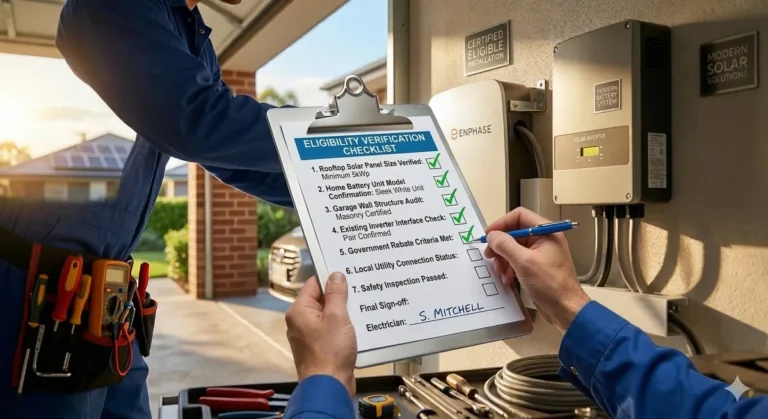
- System must be VPP-ready and installed by an accredited scheme vendor
Important Timing Note
Batteries installed before 1 July 2025 are not eligible for the rebate or loan funding. Only systems installed on or after that date qualify. If you’re considering a new installation, the scheme is currently open and accepting applications.
Your approved vendor handles the application on your behalf. You do not apply directly to the government. Loan applications (if applicable) are managed through Plenti, the scheme’s third-party administrator.
Frequently Asked Questions
What is a Virtual Power Plant and how does it work?
A Virtual Power Plant (VPP) connects thousands of home batteries into a coordinated network. When the electricity grid comes under pressure, the VPP operator draws small amounts of stored energy from participating batteries to stabilise supply. The process is automated, infrequent, and happens in the background. Your battery’s primary function remains powering your home.
How much do you earn from Synergy Battery Rewards?
Synergy Battery Rewards pays 70 cents per kilowatt-hour for energy exported during VPP activation events. For a 10 kWh battery across the maximum 30 events per year, that’s up to $210 in annual bill credits. Over a 10-year battery lifespan, that could total over $2,000 in additional savings.
Can I opt out of the VPP after joining?
Yes. The minimum VPP commitment under the WA Residential Battery Scheme is two years from the date of installation. After that period, you are free to opt out, switch to a different VPP provider, or remain enrolled. There is no penalty for leaving after the two-year minimum.
Does VPP participation drain my battery when I need it?
Your household has priority access to your battery at all times. VPP activation only draws on energy above what your household needs. Events are capped at 30 per year with a maximum duration of 6 hours each, accounting for less than 2% of the year. The vast majority of the time, your battery operates exclusively for your home.
Will VPP participation shorten my battery’s lifespan?
No. VPP events discharge your battery the same way any household load does. Modern lithium batteries are rated for thousands of charge cycles, and the additional cycling from 30 or fewer VPP events per year has negligible impact on overall battery lifespan compared to daily household use.
Ready to Join? Here’s How to Get Started
The VPP requirement is not a reason to hesitate. It’s a condition that comes with a rebate worth up to $5,000, an interest-free loan of up to $10,000, and ongoing bill credits at 70c/kWh. For most Perth homeowners, it’s one of the most financially sound home improvement decisions available right now.
The key is working with an accredited vendor who understands the scheme requirements, can confirm your equipment is eligible, and handles the application process on your behalf.
Talk Energy is an accredited WA Battery Scheme vendor serving Perth and regional Western Australia. Our team can assess your property, recommend a compliant solar and battery system, and manage the rebate application from start to finish.
Get a free quote today and find out exactly what you’d receive under the WA Battery Scheme, including your combined rebate entitlement and estimated Synergy Battery Rewards earnings.
Talk Energy: Perth’s most trusted solar and battery installer, with 250+ five-star reviews and a 20-year workmanship warranty.