Synergy and Western Power Smart Meters (2026): What Changes for Solar Owners
If you live in Perth, you probably already have a smart meter, or you will soon. Western Power calls it an advanced (AMI) meter. For solar owners it matters more than most people think. It decides which Synergy plans you can choose, how your exports are measured under DEBS, and how much detail you can see about your own usage. This guide explains what changes, what it costs and what to do if you’re adding solar or a battery in 2026.
What is a Synergy smart meter?
A Synergy “smart meter” is really a Western Power advanced meter. Western Power describes it as a digital meter with a communications card that talks to its network and monitors energy flows remotely. Synergy is your retailer, so it bills you using the data, but Western Power owns, installs and maintains the meter.
You’ll see a few names for the same thing:
- Advanced meter – Western Power’s term.
- AMI meter – short for Advanced Metering Infrastructure, the name of the program and the network behind it.
- Smart meter – the everyday term most people search for.
- Interval meter – a meter that records usage in time blocks, not just a running total.
The big difference from an old spinning-disc or basic digital meter is communication. An advanced meter sends its readings to Western Power over a radio network. That has three practical effects:
- No meter reader. Readings are taken remotely and automatically, which Western Power says reduces estimated bills.
- Faster fixes. Some faults on the service connection can be picked up remotely, and power can be reconnected remotely.
- Detailed data. Your usage is recorded in 30-minute intervals, not one total every two months.
For a home with solar, that interval data is the important part. It shows exactly when you use power and when your panels push energy back to the grid. Time-of-use plans and the DEBS feed-in tariff both depend on knowing when energy moved, not just how much.
Is Western Power replacing every meter in Perth?
Yes, over time. Western Power says it is now installing advanced meters for all new and replacement meters across its network. Its stated goal is to have more than 1,200,000 advanced meters installed by mid-2027.
Most of those meters are in the Perth metro area. The regional centres of Albany, Bunbury, Geraldton and Kalgoorlie are also covered. In July 2023 Western Power reported it had reached 600,000 advanced meters, about half of the 1.2 million meters on the South West Interconnected System. It hasn’t published a newer count that we could find, so we won’t guess at today’s number.
What this means for you:
- If your meter is new or was replaced recently, it’s very likely already an advanced meter.
- If you still have an older meter, Western Power will tell you in advance before it swaps it. You don’t need to be home, but your power will be off for around 30 minutes.
- If you’re getting solar or a battery connected, your meter usually has to be upgraded or reconfigured anyway. That’s often when older meters get replaced.
Horizon Power customers in regional WA are on a different network and different rules. This guide covers Synergy customers on Western Power’s network.
Does a smart meter cost anything?
Usually not. Synergy says there’s no upfront cost when your advanced meter is installed through the WA Government’s Advanced Metering Infrastructure program. Outside that program, you can ask for an upgrade for a fee, subject to eligibility.
Some fees can apply when you change plans or connect new equipment. These are Synergy’s published charges as at 1 July 2026, including GST:
| Synergy fee (1 July 2026) | Amount | When it may apply |
|---|---|---|
| Meter upgrade fee | $108.84 | Your meter has to be replaced to suit a plan or system |
| Meter reprogram fee | $111.60 | Your existing meter can be reprogrammed on site |
| Remote meter reprogram fee | $42.22 | The reprogram can be done remotely |
| Cellular communication fee | $431.84 | Your suburb has no radio (RF) coverage and you need remote meter reading |
The cellular fee catches people out, so here’s the detail. Western Power’s standard new meter uses radio frequency (RF) to send its data. Synergy notes that some remote suburbs don’t have RF coverage. If you live in one of those areas and need remote data collection, extra charges for cellular communications may apply. Most Perth metro homes won’t face this fee.
Will a smart meter make your bill go up? Not by itself. The meter only measures. Your bill depends on your plan, your usage and when you use it. A smart meter can change your bill only if it lets you move to a different plan, such as a time-of-use plan, and your habits suit that plan better or worse.
Which Synergy plans need an advanced meter?
All of Synergy’s time-of-use home plans need one where it’s available. Synergy’s price brochure applies the same rule to Midday Saver, the EV Add On, the EV Home Plan and the Smart Home Plan:
- If AMI is available in your suburb, you must have AMI installed to be on the plan.
- If AMI arrives in your suburb later, you’ll need to upgrade to stay on the plan.
- If you opt out of AMI and don’t upgrade, you’re moved back to the Synergy Home Plan (A1).
Here’s how the two main plans compare from 1 July 2026:
| Plan | Rates (incl. GST) | Needs an advanced meter? |
|---|---|---|
| Synergy Home Plan (A1) | 33.26c/kWh any time; 119.24c/day supply | No |
| Midday Saver | 8.85c 9am–3pm; 55.33c 3pm–9pm; 24.34c 9pm–9am; 132.78c/day supply | Yes, where AMI is available |
| EV Add On | Midday Saver rates plus 19.92c 11pm–6am (for a WA-registered plug-in EV) | Yes, where AMI is available |
| Smart Home Plan | Closed to new customers | Yes (existing customers) |
Midday Saver is built for solar homes. Grid power is cheapest in the middle of the day, when your panels are already producing. The catch is the 3pm–9pm peak rate. A battery that covers your evening load is what usually makes Midday Saver work well. For a full side-by-side, see our Synergy electricity plans compared guide, or read Synergy Midday Saver explained.
What changes for you as a solar owner?
Three things change: how your exports are measured, whether you can opt out, and the paperwork when you install. Here’s the short version.
| Topic | Old basic meter | Advanced (AMI) meter |
|---|---|---|
| Meter reading | Read on site; estimates possible | Read remotely and automatically |
| Usage detail | One total per bill | 30-minute intervals, next business day in My Account |
| Solar exports | Measured as a total | Measured by time, so DEBS peak (3pm–9pm) and off-peak rates can apply |
| Plan choice | Synergy Home Plan (A1) | A1, Midday Saver and EV plans |
| Opting out | Not applicable | Not allowed if you have solar, a battery or an EV |
| Adding solar or a battery | Meter must be replaced or reconfigured | Meter usually reconfigured, sometimes remotely |
Your meter is changed or reconfigured when solar is connected
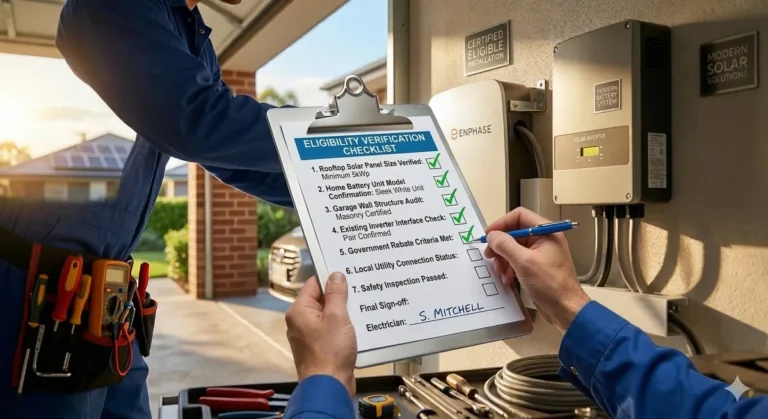
Under DEBS, Synergy says systems without an appropriate meter need a meter upgrade or reconfiguration from Western Power. Your installer lodges the grid connection application. Western Power then does the meter work after the system is installed. You don’t book it yourself.
While you wait, Synergy pays a Temporary Export Credit of 7.135c per unit exported on a net basis. Once the meter is upgraded or reconfigured, the temporary credit stops and normal DEBS rates start. Our solar installation timeline for Perth shows where this step fits.
DEBS pays by the time of day you export
DEBS pays 10c/kWh for exports between 3pm and 9pm and 2c/kWh at other times. Retailers only have to pay buyback on the first 50 kWh exported per day. Because the rate depends on when you export, interval data from your meter is what makes DEBS work. It’s also why a battery that saves midday solar for the evening is worth more than exporting it at 2c. Our Synergy DEBS feed-in tariff guide covers the rules in full.
You can’t opt out if you have solar, a battery or an EV
Some households can opt out of AMI. Synergy says the radio device is removed, the meter goes back to working as a basic meter and you read it yourself. But Synergy lists customers with solar, EVs or batteries among those who cannot opt out. For a solar home, the advanced meter is part of the deal.
Export limits and Emergency Solar Management are separate
Your meter measures exports. It doesn’t set your export limit. New or upgraded systems must be able to be turned off remotely during a low-load event; from 1 May 2026 this applies to all systems up to 30 kVA. This is called Emergency Solar Management. All new or upgraded systems are export-limited under Western Power’s 2026 rules (1.5 kW, or up to 5 kW with a retailer off-take agreement). These rules apply to your solar system, and your installer sets them up when the system is commissioned.
How do you see your smart meter data?
Log in to Synergy’s My Account. With an advanced meter, Synergy says your usage is recorded in 30-minute intervals, which is 48 readings per register each day. The data usually appears the following business day, after Western Power collects it.
In My Account you can:
- See your daily usage on the dashboard.
- See dollar values for each interval, so you can track how your bill is building up.
- Export your interval data to Excel.
Synergy updated My Account on 28 April 2026 and notes that some of its help content is under review. If a screen looks different from what’s described here, Synergy’s help pages will have the latest steps.
Why this data is worth a look before you buy solar or a battery:
- Daytime use tells you how much solar you’d use directly instead of exporting it.
- 3pm–9pm use shows your peak-time load, which is what a battery would cover.
- Overnight use helps size a battery that lasts until morning.
If you already have solar, your solar inverter or battery app usually shows production and battery use too. The meter data shows what crossed the boundary between your home and the grid. Used together, they give a clear picture of where your energy goes.
When you ask for a solar or battery quote, a few weeks of interval data is useful. It lets your installer size the system to how you actually use power, rather than a rough average from your bill.
What should you do before adding solar or a battery?
Not much. The meter side is handled as part of the connection. A few steps help you get the most out of it:
- Check your meter. Your bill or My Account shows whether you have interval data. If you do, you already have an advanced meter or an interval-capable one.
- Download a few weeks of data. Share it with your installer so the system is sized to your real usage.
- Think about your plan. If you’ll have a battery, Midday Saver may suit you. If not, compare it with A1 first, because Midday Saver’s 3pm–9pm rate is high.
- Expect a short wait for the meter. Exports earn the 7.135c temporary credit until the meter work is done, then DEBS rates apply.
- Don’t try to opt out. With solar, a battery or an EV, you can’t.
Talk Energy’s in-house SAA-accredited electricians handle solar and Sigenergy battery installs across Perth, including the grid connection paperwork. We hold WA electrical contractor licence EC15564 and have completed 5,000+ installations over 7+ years, with 4.8 stars from 300+ Google reviews. Get a free solar quote or call (08) 6255 5914.
Smart meter FAQs
Do I have to get a smart meter?
Western Power is installing advanced meters for all new and replacement meters. Some households can opt out, but Synergy says customers with solar, batteries or EVs cannot. Time-of-use plans such as Midday Saver also need an advanced meter where one is available.
Does a smart meter cost anything?
Synergy says there’s no upfront cost when it’s installed through the WA Government’s AMI program. Fees can apply for a requested upgrade ($108.84) or reprogram ($111.60). Homes without radio coverage may pay a $431.84 cellular communication fee if they need remote meter reading.
Will a smart meter make my bill go up?
Not by itself. The meter only measures your usage. Your bill depends on your plan and when you use power. It can change only if you move to a time-of-use plan, which can cost more or less depending on your habits.
How do I see my smart meter data?
Log in to Synergy’s My Account. Usage is recorded in 30-minute intervals and usually appears the following business day. You can view daily usage, see interval dollar values and export the data to Excel.
Does a smart meter work with solar export limits?
Yes. The meter measures your exports but doesn’t set your export limit. Limits and Emergency Solar Management rules apply to your solar system and inverter, and your installer configures them at commissioning.
What happens to my exports while I wait for the meter change?
Synergy pays a Temporary Export Credit of 7.135c per unit exported until Western Power upgrades or reconfigures your meter. After that, DEBS rates apply: 10c/kWh from 3pm to 9pm and 2c/kWh at other times.