WA Battery Scheme 2026: Complete Guide for Perth Homeowners
Western Australia’s home battery rebate landscape changed significantly in mid-2025, and for Perth homeowners with solar, the timing has never been better to act. Two programs now run simultaneously: the state-funded WA Residential Battery Scheme and the federal Cheaper Home Batteries Program (CHBP). Stack them correctly and you can reduce the upfront cost of a home battery system by up to $7,500.
The catch? A key federal rebate component drops on 1 May 2026. After that date, the Small-scale Technology Certificate (STC) factor falls from 8.4 to 6.8, meaning lower federal rebates for everyone installing after that deadline.
This guide covers everything Perth homeowners need to know: who qualifies, how much each program pays, how to combine them, and what the Virtual Power Plant (VPP) requirement actually means for your household.
Key Takeaways at a Glance
- WA state rebate: up to $1,300 (Synergy) or $3,800 (Horizon Power)
- Federal CHBP rebate: stacks on top for combined savings of $5,000–$7,500
- May 1, 2026 deadline: install before this date to maximise the federal component
- VPP participation: required in some areas, with genuine trade-offs worth understanding
- Over 18,000 WA households have already applied since the scheme launched in July 2025
What Is the WA Residential Battery Scheme?
The WA Residential Battery Scheme launched on 1 July 2025 as a state government initiative to accelerate home battery adoption across Western Australia. It offers direct rebates and interest-free loans to eligible households installing a new battery system.
The scheme targets two goals: reducing household energy bills and building a network of distributed battery storage that helps stabilise the WA grid during peak demand. By late 2025, over 18,000 applications had been received and more than 4,500 batteries installed, with the government targeting 100,000 households over the life of the program.
Who Administers It?
The scheme operates through WA’s two main electricity retailers:
- Synergy serves the South West Interconnected System (SWIS), which covers Perth and most of regional WA’s populated areas.
- Horizon Power serves regional and remote WA outside the SWIS, including areas like the Pilbara, Kimberley, and Goldfields.
Your retailer determines your rebate amount, and the difference is substantial.
Eligibility Requirements
To qualify for the WA state rebate, you must meet all of the following:
- Be an Australian permanent resident or citizen, aged 18 or over
- Be a current Synergy or Horizon Power customer
- Own the property, or be a renter with written landlord consent for the installation
- Have a household gross annual income under $210,000
- Install a new battery (second-hand systems are excluded)
- Use a Clean Energy Council (CEC) accredited installer
- Install a battery with a minimum usable capacity of 5.0 kWh
The battery must also appear on the scheme’s approved product list, which is updated regularly by the WA Government.
How Much Is the WA Battery Rebate?
The rebate is calculated per kilowatt-hour (kWh) of usable battery capacity, up to a maximum of 10 kWh. The rates differ significantly depending on your electricity retailer.
| Retailer | Rebate Rate | Maximum Rebate (10 kWh) |
|---|---|---|
| Synergy | $130 per kWh | $1,300 |
| Horizon Power | $380 per kWh | $3,800 |
The higher Horizon Power rate reflects the greater energy cost challenges faced by households in regional WA, where grid reliability is lower and electricity prices are typically higher.
Important: The rebate is capped at 10 kWh of usable capacity. Installing a 13 kWh battery, for example, still attracts the maximum rebate, not a proportionally higher one. This makes a 10 kWh battery the most financially efficient choice purely from a rebate standpoint, though your household’s energy needs should drive the final sizing decision.
Interest-Free Loans
In addition to the rebate, eligible households can access an interest-free loan to cover remaining installation costs. Loan eligibility follows the same criteria as the rebate, and repayments are structured to be manageable for typical household budgets. Ask your installer or contact your retailer directly for current loan terms and amounts.
How to Stack the WA Rebate with the Federal Cheaper Home Batteries Program
This is where WA homeowners have a genuine financial advantage. The state and federal programs are designed to work together, and both rebates apply to the same installation. You do not have to choose between them.
The federal Cheaper Home Batteries Program (CHBP) provides an upfront discount of approximately 30% on eligible battery systems through the Small-scale Technology Certificate (STC) mechanism. This discount is applied at the point of sale by your accredited installer, so you never need to claim it separately.
Combined Rebate Totals
| Retailer | WA State Rebate | Federal CHBP (approx.) | Combined Saving |
|---|---|---|---|
| Synergy | Up to $1,300 | ~$3,700 | ~$5,000 |
| Horizon Power | Up to $3,800 | ~$3,700 | ~$7,500 |
Federal rebate amount is approximate and varies by battery size and STC zone. Figures are based on a 10 kWh system installed before 1 May 2026.
Why 1 May 2026 Matters
The federal rebate is calculated using an STC deeming factor. On 1 May 2026, that factor drops from 8.4 to 6.8 as part of a pre-scheduled step-down in the program. In practical terms, this means the federal component of your saving will be lower for any installation completed after that date.
The difference is meaningful: for a typical 10 kWh system, installing before 1 May 2026 versus after could represent several hundred dollars in additional federal rebate. Given that installation lead times for accredited vendors can run four to eight weeks, homeowners who want to capture the maximum combined saving need to be getting quotes now, not in April.
Note: The WA state rebate ($1,300 for Synergy, $3,800 for Horizon Power) is not affected by the May 2026 deadline. Only the federal component changes.
Understanding the VPP Requirement: What It Means for Your Household
VPP participation is a condition of eligibility under the WA Residential Battery Scheme. This is the part of the scheme that generates the most questions, and it deserves an honest answer rather than a footnote.
What Is a Virtual Power Plant?
A Virtual Power Plant connects thousands of individual home batteries into a coordinated network. During periods of high grid demand, the network operator can draw small amounts of stored energy from participating batteries to stabilise the grid, instead of firing up expensive gas peakers. In exchange, participating households typically receive bill credits or a reduced electricity tariff.
WA has over 550,000 rooftop solar systems, according to the WA Government. The VPP model turns that distributed resource into something the grid can actually use.
The Real Trade-Off
Here is what critics of the VPP requirement point out, and they are not wrong: during an orchestration event, the grid operator controls a portion of your stored energy. For a brief window, you may not have full access to the charge you would otherwise use.
In practice, orchestration events are infrequent and short-lived. Most households will not notice them day-to-day. But if uninterrupted control of your battery is a priority, this is a genuine consideration.
Why It Still Makes Sense for Most Homeowners
Weigh the trade-off against the numbers:
- You receive up to $7,500 in upfront rebates in exchange for two years of VPP participation
- The VPP commitment is only two years. After that, you can opt out at any time under the scheme’s terms
- Synergy customers can choose their VPP provider, as long as it meets the state’s criteria, giving you some control over the terms
- You still self-consume your solar first. The VPP only activates during specific grid events, not continuously
For the vast majority of Perth households, the financial benefit of the rebate far outweighs the limited and temporary reduction in battery autonomy. The two-year opt-out clause is a meaningful safeguard that many commentators overlook.
How to Apply: Step by Step
The application process is simpler than most homeowners expect. You do not apply directly to the government. Your accredited vendor handles the submission on your behalf.
- Check your eligibility using the criteria above. Confirm you are a Synergy or Horizon Power customer, own or have landlord consent for your property, and meet the income threshold for a loan if needed.
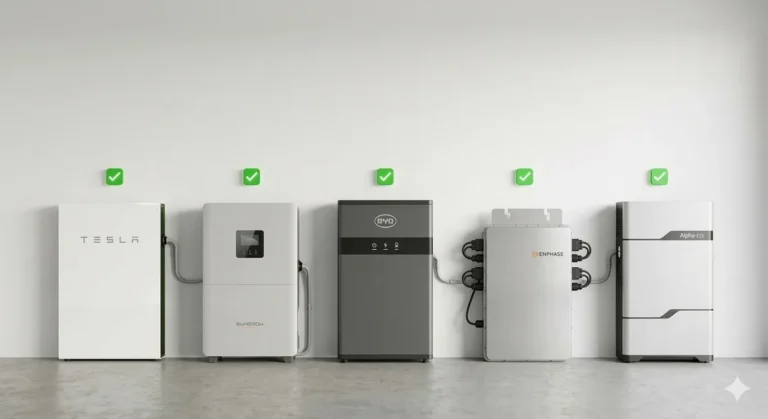
- Get quotes from approved vendors. Only vendors accredited under the scheme can submit applications. The WA Government’s approved vendor list is the definitive source. Make sure the battery and inverter combination is on both the CEC Approved Battery List and Synergy or Horizon Power’s Supported Solutions List.
- Select your battery system. Minimum 5.0 kWh usable capacity. Your vendor will confirm the system is VPP-compatible for your network area.
- Your vendor submits the rebate application. If approved, you have up to six months to complete the installation before the approval expires.
- Apply for the no-interest loan (optional). If you want the loan component (up to $10,000 at 0% interest over 3–10 years), you will be contacted by Plenti, the scheme’s third-party loan administrator, for a credit check.
- Installation is completed by your accredited vendor. The rebate is applied as a direct reduction to your installation cost.
One important note on property: renters can participate if their landlord provides written consent for the installation. The property must also have a reliable internet connection, as this is required for VPP monitoring and orchestration.
Is the WA Battery Scheme Worth It for Perth Homeowners?
The honest answer is: for most Perth homeowners with existing solar, yes. Here is the reasoning.
A quality 10 kWh home battery system typically costs $10,000–$14,000 installed before rebates. With combined state and federal rebates of up to $5,000 (Synergy) or $7,500 (Horizon Power), the effective out-of-pocket cost drops to $6,500–$9,000 for Synergy customers, and as low as $2,500–$6,500 for Horizon Power customers. That is a materially different investment proposition than buying without rebates.
The Case for Acting Now
- Perth’s high solar irradiance means batteries charge fully on most days, maximising self-consumption
- The May 2026 STC step-down reduces the federal component for anyone who waits
- WA’s 550,000+ solar households have been exporting excess power at low feed-in tariffs; a battery captures that value instead of selling it cheaply back to the grid
- Interest-free financing up to $10,000 removes the barrier of upfront cost entirely for eligible households
The Case for Caution
Some analyses have questioned whether batteries deliver meaningful savings after accounting for depreciation. Those analyses are worth taking seriously. However, they typically assume no rebate and full retail battery pricing. With $5,000–$7,500 in combined rebates applied upfront, the financial equation shifts considerably. The payback period shortens, and the break-even point becomes achievable within a realistic battery lifespan.
The scheme is not a perfect fit for every household. If your solar system is undersized, if you use very little electricity at night, or if your property has shading issues that limit solar generation, a battery may not deliver the expected returns. A proper assessment from an accredited installer will tell you where you stand.
The bottom line: The combination of state rebates, federal CHBP, and interest-free financing makes 2026 the most financially favourable time to install a home battery in WA’s history. The May 2026 deadline adds a concrete reason not to delay.
Frequently Asked Questions
How much is the WA battery rebate for Perth homeowners?
Perth homeowners on the Synergy network receive up to $1,300 ($130 per kWh, capped at 10 kWh). Horizon Power customers in regional WA receive up to $3,800 ($380 per kWh). When stacked with the federal Cheaper Home Batteries Program, total combined savings reach $5,000 to $7,500 depending on your retailer and system size.
Can I combine the WA state rebate with the federal battery rebate?
Yes. The WA Residential Battery Scheme and the federal Cheaper Home Batteries Program (CHBP) are designed to stack. Both rebates apply to the same battery installation. Your accredited installer applies both discounts at the point of sale, so you receive the full combined saving upfront without separate claims.
What happens after the 1 May 2026 STC deadline?
On 1 May 2026, the Small-scale Technology Certificate (STC) deeming factor drops from 8.4 to 6.8. This reduces the federal rebate component by several hundred dollars for a typical 10 kWh system. The WA state rebate is not affected. With installation lead times of four to eight weeks, homeowners should be getting quotes now to ensure installation is completed before the deadline.
Do I have to participate in a Virtual Power Plant (VPP)?
VPP participation is a condition of the WA Residential Battery Scheme. The commitment is for two years, after which you can opt out. During VPP events, the grid operator may draw small amounts of stored energy from your battery to stabilise the grid. These events are infrequent and short-lived, and you still self-consume your solar energy first.
Can renters apply for the WA battery scheme?
Yes. Renters can participate in the WA Residential Battery Scheme if their landlord provides written consent for the battery installation. The property must also have a reliable internet connection for VPP monitoring. All other eligibility criteria (income threshold, CEC accredited installer, minimum 5 kWh battery) apply equally to renters and homeowners.
Book a Free Consultation Before the May 2026 Deadline
Talk Energy is an approved WA Battery Scheme vendor serving Perth and regional WA. Our in-house electricians handle the entire process, from eligibility check and product selection through to installation and VPP enrolment, so you are not coordinating between multiple parties.
With the 1 May 2026 STC deadline approaching and installation lead times running four to eight weeks, the window to lock in maximum combined rebates is closing. Book a free consultation with Talk Energy today and we will confirm your eligibility, size the right battery for your household, and manage the rebate application on your behalf.
Talk Energy: Perth’s most trusted solar and battery installer, with 250+ five-star reviews and a 20-year workmanship warranty.