Why Use a Local Perth Solar Installer vs a National Chain? What Talk Energy Does Differently
When Perth homeowners search for solar installers, the marketing from national brands is polished and reassuring. Big logos, slick websites, claims of thousands of installations across Australia. It feels like stability.
But stability for whom?
A national solar company’s brand reputation is built across every state. Their customer service team is in another city. Their warranty department routes claims through a head office that has never seen your roof, your suburb’s grid constraints, or the particular way afternoon sun hits your street in summer. When something goes wrong with your system in five years, you are not a local customer with a relationship. You are a ticket number.
This article is not an argument against all large installers. It is an honest look at what the local versus national choice actually means for Perth homeowners, and the specific factors that make that choice more consequential here than almost anywhere else in Australia.
What Actually Happens When a National Chain Installs Your Solar
National solar retailers operate on a model that works well for them and carries real risks for you. Understanding how that model works is the first step to making an informed decision.
The subcontractor chain
Most large national installers do not employ the people who actually install your panels. They act as retailers: they take your order, handle finance, and then subcontract the physical installation to local electrical contractors in each state. That subcontractor may be excellent. They may also be whoever was available at the time of booking.
The person on your roof has no ongoing relationship with the company whose name is on your contract. If there is a problem with the installation, the national retailer must first establish whether the fault lies with their subcontractor, the equipment manufacturer, or the design. That process takes time, and the customer is stuck in the middle.
Centralised call centres and interstate warranty claims
When you call a national installer after installation, you are typically speaking to a contact centre that may be in Sydney, Brisbane, or offshore. They have no direct knowledge of Western Australian grid requirements, Western Power’s technical standards, or the specific conditions in your suburb.
Warranty claims follow a similar path: logged centrally, assessed remotely, and resolved on a timeline driven by the national business’s workload, not your urgency. A Perth homeowner waiting on a warranty repair is competing for attention with customers in Queensland, Victoria, and NSW.
Variable service quality between states
A national brand’s reputation is averaged across its entire operation. A company with strong installers in Melbourne and poor subcontractors in Perth will present the same brand to both markets. There is no reliable way for a Perth customer to know which version of the business they are getting until after the installation is complete.
The real risk: You are not buying a nationally consistent product. You are buying a lottery ticket on which local subcontractor happens to be available.
Why Perth Is a Special Case
Perth is not just geographically isolated from the rest of Australia. Its solar market operates under a distinct regulatory and technical environment that genuinely requires local expertise.
Western Power’s grid is unlike any other state
Perth’s electricity network is run by Western Power and retailed primarily through Synergy, a structure that exists nowhere else in Australia. The rules governing how solar systems connect to this grid are specific to Western Australia, and they have just changed significantly.
From 1 May 2026, new connection requirements came into effect for all new and upgraded solar and battery systems on the South West Interconnected System (SWIS). Every new installation must now choose between two export pathways:
| Export Pathway | What It Means |
|---|---|
| Full remote disconnection (VPP-ready) | Full access to DEBS feed-in tariffs and future Virtual Power Plant programs. Requires CSIP-AUS communications capability. |
| Capped 1.5 kW export | No ongoing connectivity needed after installation testing, but export earnings are limited. No DEBS payments, no VPP eligibility. |
An installer who does not understand Western Power’s SWIS requirements, Synergy’s commissioning process, or the CSIP-AUS standard risks configuring your system incorrectly at the point of installation. That mistake could lock you into a capped export arrangement, costing you thousands of dollars in lost feed-in tariff income over the life of your system.
A national installer based in Sydney or Brisbane is unlikely to have this knowledge embedded in their sales and design process. A Perth-based installer who works in this grid every day does.
Perth’s climate and roof types
Perth receives some of the highest solar irradiance of any capital city in Australia. That is an advantage, but it also creates specific challenges: high ambient temperatures that affect panel efficiency, coastal salt exposure in suburbs near the ocean, and the prevalence of terracotta tile roofs common in older Perth homes that require specific mounting techniques.
These are not abstract considerations. They affect system design, panel selection, and the long-term integrity of the roof penetrations made during installation. A local installer who has worked across Fremantle, the northern suburbs, and the Swan Valley understands these variables from experience, not from a national installation guide.
The Insolvency Risk No One Talks About
There is a risk in the Australian solar market that is rarely discussed in sales conversations but affects hundreds of thousands of homeowners: installer insolvency.
Over 800 Australian solar companies have failed since 2011. Estimates from CHOICE and industry researchers suggest that between 600,000 and 700,000 solar systems across Australia are now “orphaned,” meaning the company that installed them no longer exists. That represents roughly 31% of all installed systems in the country.
When your installer goes out of business, here is what you lose:
- Workmanship warranty: Completely voided. No one is obligated to fix installation errors, roof penetration leaks, or wiring faults.
- Production guarantees: Any promises the installer made about system output are gone with the company.
- Service relationship: The team that knows your system, your roof, and your connection setup no longer exists.
Product warranties from panel and inverter manufacturers generally survive an installer’s collapse, because those warranties are between you and the manufacturer. But the workmanship warranty, which covers the quality of the installation itself, is only as strong as the company that issued it.
Why community ties matter for warranty durability
A business that is deeply embedded in a local community faces a different set of incentives than a national company managing customers across five states. Local businesses depend on word-of-mouth referrals from neighbours, friends, and local networks. A reputation built over years in a single city is far harder to abandon than a centralised operation that can rebrand or restructure interstate.
This is not sentiment. It is a practical risk assessment. When choosing a solar installer, the question is not just “are they accredited today?” It is “will they still be here in year seven when I need a warranty repair?”
The answer to that question is more reliably yes for a locally owned business with a physical presence in your city, a long history of community reviews, and no reason to exit the market they have built their reputation in.
What Talk Energy Does Differently
Talk Energy Solar & Battery is a Perth-owned, Perth-operated solar and battery retailer based at 16 Ogilvie Road, Mount Pleasant. That address is not a marketing point. It is a statement of accountability.
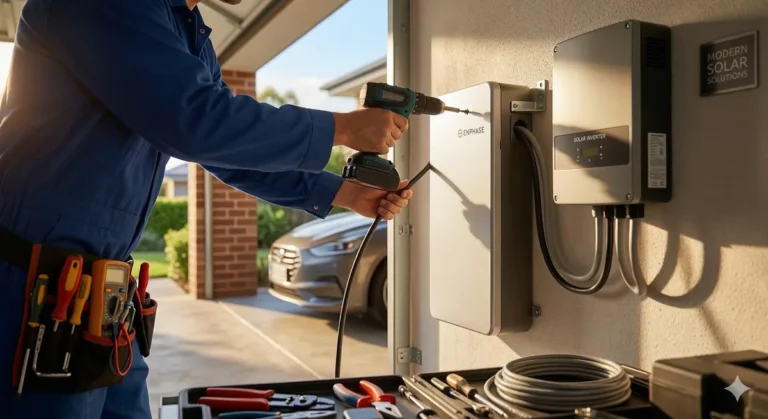
When you call Talk Energy, you reach people who live and work in Perth. When your system needs a post-installation visit, the same in-house electricians who installed it can return to your property. There is no subcontractor chain, no interstate warranty routing, and no call centre in another time zone.
In-house electricians, not subcontractors
Talk Energy employs its own licensed electricians. This is a meaningful structural difference from the national retailer model. It means:
- The team that designs your system is the same team that installs it
- Post-installation service calls are handled by people who know your specific setup
- Warranty claims are resolved by the company that holds the warranty, not passed to a third party
- There is a direct line of accountability from sale to installation to aftercare
Local knowledge of Western Power requirements
Talk Energy’s team installs exclusively in Western Australia. They work within Western Power’s grid every day, understand the network hosting capacity constraints that vary by suburb, and are fully across the updated connection requirements that came into effect on 1 May 2026. That includes the CSIP-AUS commissioning standard required for Synergy customers who want full DEBS access and VPP eligibility.
For Perth homeowners, this is not a minor detail. Getting the export pathway wrong at commissioning can mean years of reduced feed-in tariff income. A locally embedded installer is far less likely to make that mistake.
A 4.8-star rating from 300+ Perth Google reviews
Talk Energy holds a 4.8-star rating from more than 300 Google reviews by verified Perth customers. These are not reviews spread across multiple states or averaged across a national operation. They are from people in Perth suburbs, people who can be asked directly about their experience, and whose feedback reflects the same local service you would receive.
That volume of consistent local reviews is a meaningful signal of ongoing accountability. A business does not maintain that record by treating post-installation service as someone else’s problem.
A 20-year workmanship warranty
Talk Energy backs its installations with a 20-year workmanship warranty. This is significantly longer than the industry standard of five to ten years, and it is only a meaningful commitment because Talk Energy is a locally anchored business with every incentive to still be operating in Perth two decades from now.
How to Verify Any Installer’s Credentials
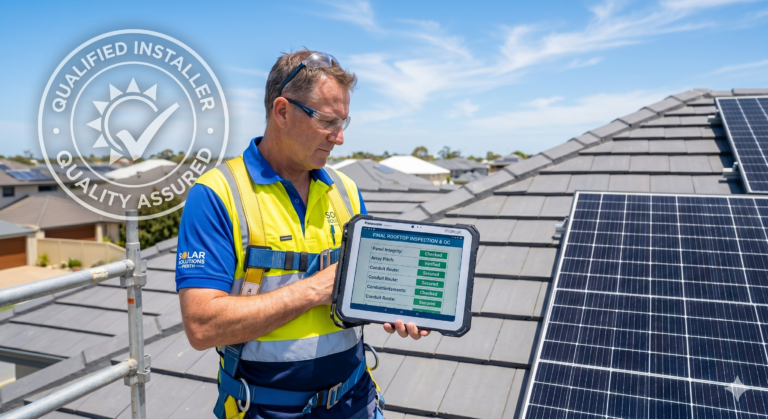
Regardless of which installer you choose, there is one non-negotiable verification step: check the accreditation of the electricians who will actually do the work.
Solar installer accreditation in Australia is administered by Solar Accreditation Australia (SAA), which took over from the Clean Energy Council. Accreditation is held by individual electricians, not by companies — so the question to ask is whether the people actually on your roof are accredited, not whether the business displays a logo. Accredited installers are required for systems to be eligible for the federal Small-scale Renewable Energy Scheme (SRES) rebate, and an installer without accreditation cannot legally issue the paperwork required to claim it.
Beyond installer accreditation, verify:
- ABN status: Search the company’s ABN on the Australian Business Register to confirm the business is currently registered and active.
- ASIC status: Check the company name on ASIC Connect to confirm it is not in liquidation, administration, or deregistration proceedings.
- Local reviews: Look specifically for reviews from customers in your state, not aggregate national ratings. A Perth customer’s experience is more relevant than a national average.
- Physical address: A verifiable local address is a basic indicator of accountability. A business without a local presence has less at stake in your community.
10 Questions to Ask Before Choosing a National vs Local Solar Installer
Use this checklist when comparing quotes from any solar installer, local or national.
- Do you employ your own electricians, or do you subcontract installations? The answer tells you who is actually accountable for the quality of work on your roof.
- Where is your warranty claims team based, and what is the average resolution time for a Perth customer? This reveals the practical reality of post-installation support.
- Are the electricians who will install my system SAA-accredited, and can you provide their accreditation numbers? Verify these independently with Solar Accreditation Australia.
- How long has your business been operating in Western Australia specifically? National longevity is not the same as local experience.
- Are you familiar with Western Power’s updated connection requirements from May 2026, and which export pathway will you commission my system under? A blank or vague answer is a significant red flag.
- What is the length of your workmanship warranty, and who honours it if your business changes structure or ownership? Five years is standard; ten or more is better; twenty is exceptional.
- Can you provide references from customers in my suburb or nearby areas who have had their systems installed for at least three years? Recent installations have not yet tested the post-installation relationship.
- What is your process for handling a warranty claim, from first contact to resolution? Ask for this in writing before signing.
- How do I check your company’s current status on the ASIC register? Any installer who discourages this check is worth avoiding.
- If I need a site visit after installation, how quickly can you attend, and will it be someone from your own team? The answer reveals whether local accountability is real or just marketing language.
The Bottom Line for Perth Homeowners
Solar is a 25-year investment. The panels on your roof will still be generating electricity long after the salesperson who quoted you has moved on. The question worth asking is not which company has the biggest marketing budget. It is which company will still be answering the phone in Mount Pleasant when you need them.
Local accountability is not a soft benefit. It is a structural advantage that affects the quality of your installation, the reliability of your warranty, and the expertise applied to a grid that operates under rules unique to Western Australia.
Talk Energy Solar & Battery is based at 16 Ogilvie Road, Mount Pleasant, employs its own in-house SAA-accredited electricians, backs every installation with a 20-year workmanship warranty, and holds a 4.8-star rating from more than 300 Google reviews by Perth customers. That combination of local presence, technical expertise, and long-term warranty commitment is the standard Perth homeowners should hold every installer to.
If you are comparing solar quotes in Perth and want a straight conversation about your options, system design, and what Western Power’s current connection rules mean for your specific property, contact Talk Energy for an obligation-free assessment.